


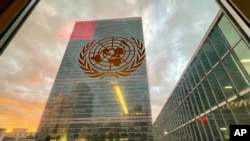
Editor's note: this story was translated from the original VOA Pashto article.
As Afghanistan marks 80 years as a member of the United Nations, the country’s seat in the world body remains in limbo, with no clear path for the Taliban to gain recognition.
Afghanistan’s permanent representative to the U.N., Nasir Ahmad Faiq, appointed by the former Afghan government, told VOA that the U.N. has rejected the Taliban’s bid to take over Afghanistan’s seat.
“This shows that the international community is not ready to recognize or normalize relations with the Taliban as the legitimate government of Afghanistan,” he said.
No country except Russia has recognized the Taliban as the legitimate government of Afghanistan, although several countries maintain working relations with the group.
In the five years since the Taliban seized power in Afghanistan, the U.N. has declined to hand over Afghanistan’s seat to the group, while the representative appointed by the former government has continued to serve.
Faiq said his mission is to amplify the voices of Afghans, particularly Afghan women and girls.
“Our message is clear: The Afghan people should not be forgotten. The rights of girls to education and work, the rights and freedoms of all citizens and their participation in determining the country’s future should be at the center of international efforts," he told VOA.
The Taliban, however, called the U.N.'s refusal to hand over Afghanistan’s seat to their representative ‘injustice’ and urged the world body to recognize them as the country’s government.
Shinkai Karokhail, a former Afghan ambassador to Canada, told VOA that the Taliban failed in their pursuit of both domestic and international legitimacy.
The international community has linked the Taliban government’s recognition to respect for human rights, the establishment of an inclusive government and efforts to combat terrorism.
Karokhail said that Afghanistan is a signatory to various conventions and has endorsed numerous declarations and resolutions, adding that “the Taliban should have upheld those international commitments but instead defied them.”
Afghanistan joined the U.N. in November of 1947, a year after the world body was formed. The country was one of the first Muslim-majority states to vote for the Universal Declaration of Human Rights in 1948. In the years that followed, Afghanistan signed a number of international treaties that required governments to respect human rights and uphold certain international legal standards.
“Eight decades later, Afghanistan remains a member of the United Nations and has made significant contributions to multilateralism, but its people have gone through decades of war, foreign intervention, instability, displacement and serious human rights violations,” said Richard Bennett, U.N. special rapporteur on the situation of human rights in Afghanistan.
Bennett told VOA that the U.N. has played a vital role in Afghanistan through humanitarian assistance, development programs, efforts to document human rights abuses and work to promote dialogue and peace initiatives.
He added that the anniversary is also an opportunity to reflect on the U.N.’s shortcomings and the opportunities it missed in Afghanistan over the years.
“Despite decades of international engagement, Afghanistan has serious human rights violations. One of the most painful examples is the situation of Afghan women and girls. After two decades of progress, they have lost many of their hard-won rights and freedoms while the international community has struggled to respond effectively,” Bennett told VOA.
Shukria Barakzai, former Afghan parliamentarian and Afghanistan’s ambassador to Norway, told VOA that the Taliban’s policies made Afghanistan an isolated country in the world.
She said that the engagement that should exist between Afghanistan and the international community is lacking.
“The country remains isolated, and, unfortunately, the will of its people in determining the political system is being disregarded,” she said.