


Editor's note: this story was translated from the original VOA Mandarin article.
New satellite imagery shows Chinese-made light attack aircraft and military vehicles deployed at a newly opened Chinese-supported air facility in Laos, fueling debate among security analysts over whether the site could eventually expand Beijing’s military reach and intelligence-gathering capabilities in mainland Southeast Asia.
The Ban Keun Airport, about 50 kilometers northwest of the Lao capital Vientiane, was officially inaugurated by China and Laos as the “China-Laos Ban Keun Airport Joint Support and Training Center” and the China-Laos Friendship Aviation Academy.
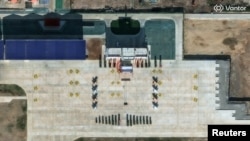
Satellite imagery taken September 30 showed eight aircraft and more than 20 military vehicles at the site, according to a Reuters report. Analysts identified the aircraft as Chinese-made Hongdu JL-8 jet trainers, also known as K-8 light attack aircraft.
The facility currently has a roughly 2,000-meter paved runway, alongside aircraft parking areas, a control tower and newly constructed buildings. China’s Defense Ministry says the center is intended to help Laos strengthen the training of air force pilots and is “not directed against any third party.”
Some analysts say its longer-term significance, however, could go beyond pilot training.
Su Tzu-yun, director of the Division of Defense Strategy and Resources at Taiwan’s Institute for National Defense and Security Research, told VOA that if the runway is eventually extended to about 3,000 meters, it could accommodate larger Chinese bombers, transport aircraft and aerial refueling planes.
Deployment of longer-range combat aircraft theoretically could extend Chinese air power toward the Strait of Malacca and, with aerial refueling, farther into the Indian Ocean, he said.
Su said the location has limitations because landlocked Laos is surrounded by countries whose airspace could constrain Chinese operations. He sees Ban Keun as part of a broader effort by Beijing, though, to develop strategic access across mainland Southeast Asia.
“This is one of the main reasons China promoted the Belt and Road Initiative after Xi Jinping took office,” Su told VOA. “Through economic incentives, it invests in ports and airports in other developing countries, but behind that are strategic and military purposes.”
China has invested heavily in regional infrastructure, including the China-Laos railway, while expanding its military presence elsewhere, most notably at its base in Djibouti and through its involvement at Cambodia’s Ream Naval Base.
Su said the combination of transportation infrastructure, ports and potential military access could give China alternative routes connecting the Pacific and Indian oceans and reduce its vulnerability if maritime supply lines through the Strait of Malacca were disrupted.
But other analysts caution against overstating Ban Keun’s immediate military importance.
Collin Koh, a maritime security specialist at the S. Rajaratnam School of International Studies in Singapore, told VOA by email that Ban Keun currently has “more political-symbolic significance than actual operational significance.”
Nonetheless, he said the facility could support China’s growing defense diplomacy in Southeast Asia, including serving as a logistical stop during joint military exercises.
It also may have value for intelligence, surveillance and reconnaissance, Koh said. “Ban Keun could also serve as a base for intelligence and surveillance missions, mainly monitoring Thailand’s Isaan region,” he said. “Various multinational military exercises are routinely held in this area, such as Cope Tiger involving Thailand, the United States and Singapore.”
Koh said China’s relationship with neighboring Myanmar does not necessarily mean Beijing will gain military access there. Myanmar is seeking to rebuild relations with other regional countries, he said, including India, which is particularly sensitive to potential Chinese military expansion toward the Indian Ocean.
Additionally, the emerging Chinese presence in Laos is drawing attention because of its proximity to Vietnam.
Alexander Vuving, a Vietnam specialist at the Daniel K. Inouye Asia-Pacific Center for Security Studies in Hawaii, was cited by Taiwan’s Central News Agency as saying Chinese access at Ban Keun, combined with its presence at Cambodia’s Ream Naval Base, could increase strategic pressure on Vietnam from its west and southwest.
Chinese military commentator Song Zhongping rejected suggestions that Beijing is establishing a network of bases aimed at neighboring countries.
He told VOA that China’s activities at Ban Keun and Ream should not be characterized as traditional military bases and stated that the limited deployments are designed to protect Chinese interests and support missions, such as counterterrorism, anti-piracy, and humanitarian assistance.
“China now has three aircraft carrier battle groups, and we already possess a basic capability to project military power overseas,” Song said. “We do not necessarily need to establish so-called military bases in other countries.”
For now, analysts interviewed by VOA generally agree the facility is unlikely to significantly alter the regional military balance, though its development is being closely watched as China expands its economic, diplomatic and security footprint across Southeast Asia.